Our Services
What can Ciniva do for your company?
Learn About Services

When the dust settled and the final tallies were in, we were left with the strongest Black Friday on record. Retailers collected a whooping $11.8 billion in sales—a 9.1% increase YOY. What is more eye opening is the fact these figures were posted during a year in which U.S. sentiment toward the economy is its lowest in decades. So what was the driving force behind the increase? As we continue reading, you will see it was AI tools which made the difference.
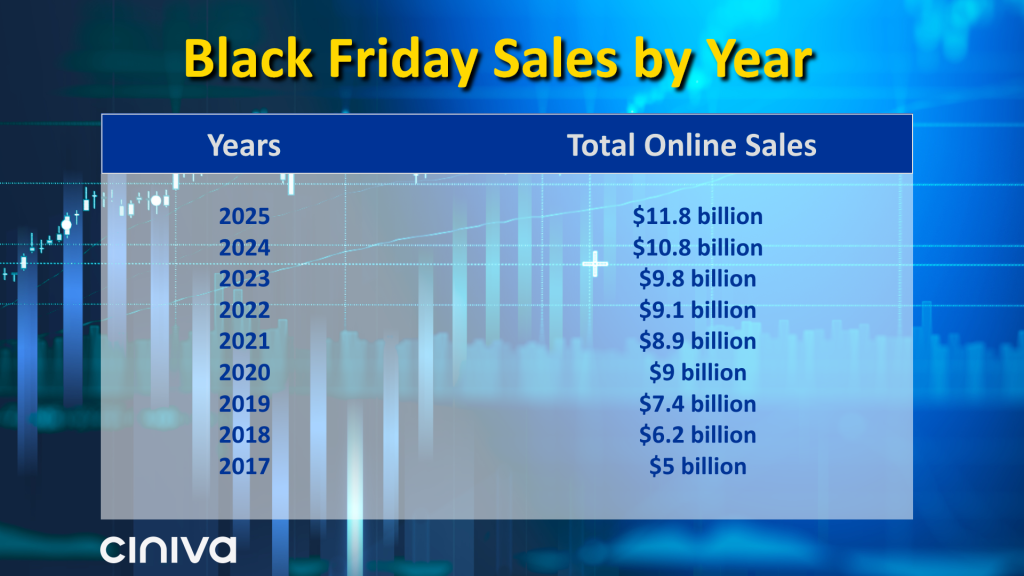
A chart showing Black Friday “Total Online Sales by Year” for the years of 2017 through 2025 (Data sources: Reuters, Salesforce, Mastercard)
AI-powered deal brokers directed an 805% boost in AI traffic, according to Adobe. AI agents handled the search process, model comparisons, and even checkout. The unspoken reality is that this season’s “winners and losers” in retail were already decided before consumers typed in their first query. Showing up in AI’s recommendations is what will drive commercial success going forward. Digital Marketing hasn’t seen this big of a seismic shift since the golden age of the .com era.
As discussed in our previous blog article (The Top 5 Reasons Holiday Shopping has a Different Feel This Year – Ciniva Digital Notes), users are now using Generative AI for a plethora of reasons. This can span from simple bargain hunting to intricate personalization options. Many companies are installing AI-powered shopping assistants, setting off an arms race amongst the heavy hitters. Major tech firms like OpenAi, Google, and Perplexity boast recent launches aimed at simplifying the gift finding process. Walmart and Amazon have entered the fray with their own AI companions, called “Sparky” and “Rufus,” respectfully.
The changes are building momentum that carries beyond the holiday season. Instacart’s new integration with ChatGPT, allows users to plan out meals, select grocery lists, and even complete the purchase without ever leaving the chat window. We are sure to see others follow suit. AI tools are moving beyond simply providing recommendations to actually executing the purchases.
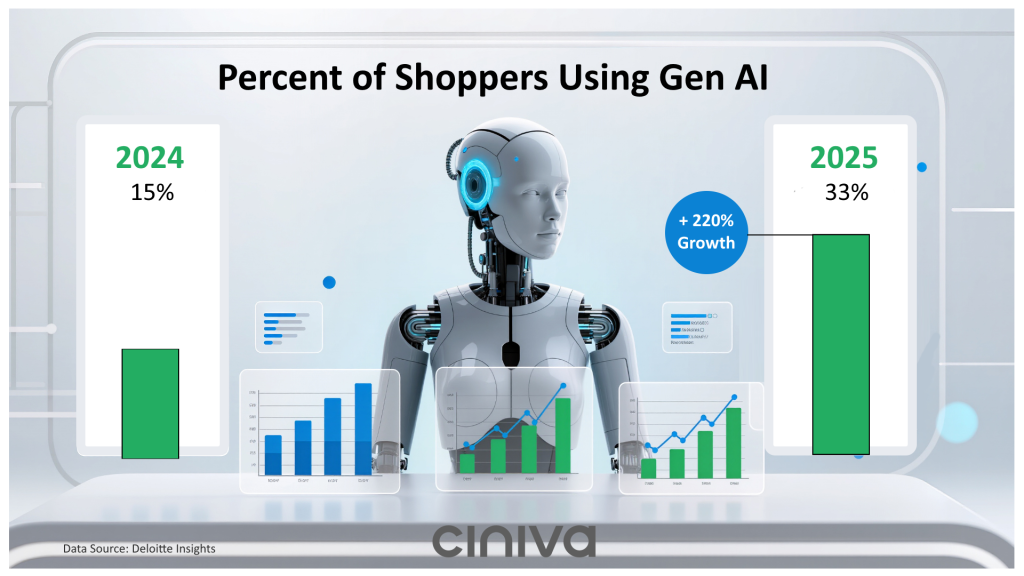
Despite all of the forward momentum, testing reveals the technology still has its drawbacks. Issues range from sluggish processing speed to limited checkout options, which may only function for select brands. Another hurdle is data availability. For instance, Amazon disallows competitors such as Google and OpenAI from obtaining its product catalog, which creates a massive gap for comparison shopping. Most consumers will still visit retailer websites directly or perform other online search actions, or even patron physical stores to fulfill their holiday shopping this year.
Still, it’s obvious that the long-term and even mid-term trajectory is calibrated toward a seamless and fully integrated AI shopping experience sooner rather than later.
Does your head feel numb from trying to keep up with all the changes? You are not alone! Reach out to our Ciniva Team to learn how we can help execute a personalized marketing and AI strategy. We do the heavy lifting on the tech side for you so that you can focus on the day-to-day demands of running your business.