Our Services
What can Ciniva do for your company?
Learn About Services

The way consumers shop for products online has permanently shifted. To be successful, you need to know how to optimize your brand for conversational search. Traditional search no longer cuts it. Rather than typing in disjointed keywords such as “laptop, 12 GB RAM, under $1,000,” shoppers now phrase questions naturally, such as “What is the best laptop under $1,000 for graphic design and video work?”
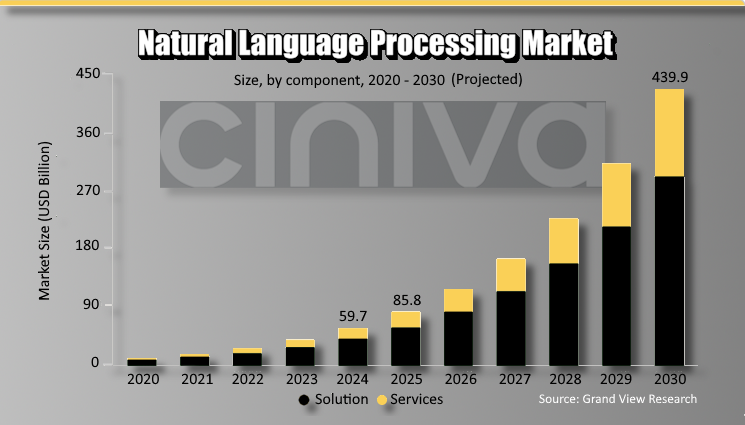
Traditional keyword search now seems light-years behind conversational search. The gap only continues to widen, as modern NLPs (Natural Language Processors) are able to respond to increasingly complex requests. The international NLP market is projected to grow from $59.70 billion in 2024 to $439.85 billion by 2030 (1).
The ability to succinctly and accurately process all of this information through artificial intelligence is the power behind the change. Machine learning and NLP algorithms interpret the long-tail queries that drill down to the heart of user intent.
This is why AI shopping assistants hit the spotlight in 2025 (Reflecting on This Year’s Record-Shattering Black Friday – Ciniva Digital Notes) and continue to grow in popularity. The major retailers have either launched their own shopping assistants or have partnered with a third party to launch one. These new search systems use AI agents that factor in previous interaction history, as well as layers of real-time retailer and consumer data.
With so much data packaged within a human-like conversational interface, purchasers have taken notice: a whopping 93% of shoppers say it’s important that ecommerce search understands conversational queries (2). To remain relevant, you absolutely must know how to optimize your brand for conversational search.
Equally noteworthy, early data shows it is lucrative for businesses. AI-powered chat increases conversion rates by 4X (12.3% vs 3.1%), and shoppers complete purchases 47% faster when assisted by AI (3).
Search used to be all about rankings, but now it’s largely about relevance and response. Users want logical, human-like responses from shopping assistants. Your website content needs to be AI-friendly in order to resonate with today’s shoppers and to ensure digital assistants choose your brand. Here are the top 10 tips on how to optimize your brand for conversational search:
AI selects natural-sounding content that is easy to comprehend. Ditch the keywords and focus on conversational writing. Keep answers brief and targeted. Be sure to adhere to solid writing principles, such as varying sentence length and structure.
Conversational search is question-based. Provide content that clearly answers common questions in a succinct, conversational manner. Be aware that with the ease of voice-activated tech, slightly longer, more specific questions are becoming the norm.
AI summarizes content quickly for Google’s Search Generative Experience (SGE). Prioritize concise, 2-3 sentence summaries with clear takeaways to maximize your exposure. Be sure to clearly label your content to help AI categorize it, with schema markup such as “FAQs” or “How To,” etc.
Provide responses that naturally lead to the next question. Think of it as a conversation. Always consider what the next logical question would be if you were talking with an actual client. Remember that conversational AI builds off of previous inquiries, so match your content to follow a similar pattern.
Beyond quick, surface level material to attract AI summaries, there is an inherent benefit to building out content pages that go deep in a specific topic. For example, including a core theme such as “The Ultimate Guide to Choosing the Right Computer for Your Needs” can help establish your authority, especially if you interlink it with other themed pages.
Include information unique to your organization. This could include quotes from your founder, satisfied customers, or industry experts. Have you produced any primary research or survey data? Share it! Build your expertise for AI to draw on for specific long-tail inquiries.
In the past, having the right keywords gave you visibility. However, with today’s AI systems, user needs trump specific keywords. AI seeks answers that align with use cases supplied by potential clients, and so relevancy will help you gain visibility over keyword stuffing.
With so many customers receiving answers and making purchasing decisions within the AI assistant infrastructure, many users will not even need to visit your website. Be sure to build your brand name into your FAQs and other content.
AI systems update faster than the old Google infrastructure. According to Forbes, new articles begin appearing in ChatGPT and Perplexity citations within two days of publishing (4). Consistent, high-volume output correlates positively with being found by the AI search engines.
Check in to see how/if platforms like ChatGPT are referencing your organization. Compare your content to competitors, particularly those with a strong presence in AI systems, such as Google Search Summaries and Bing AI. Keep updating your content and continue to optimize.
If you’re struggling to keep up with all the changes, you are not alone! Our Ciniva Team is standing by to help you execute a personalized marketing and AI strategy. We bring the expertise needed to thrive in today’s AI-heavy market, so that you can focus on the other demands of running your business. Reach out today for a free consultation!